
On ice, mathematics and education vs. skills acquisition
That's the ice forming like a second coastline on the first evening of the big storm. The tides of the Hudson estuary froze in place. Yes, the Hudson is called a river, but its freshwater flows into the sea, and the tide brings salty water back upstream.
You'd think the salt would lower the freezing point of the water, but we were beyond all that. (continued below)
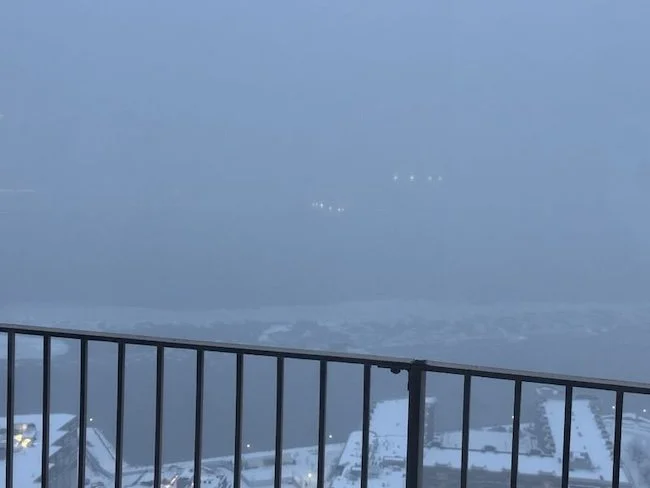
The lights of the Manhattan bank could be seen, but barely. Then came the ice floes. Finally, a light skim of ice glued everything together.
There are steps in a disaster.
We watched geology in fast-forward. The cliffs of the Palisades on the New Jersey side were formed in the ice age. Morningside Heights, that neighborhood near Columbia University? Glaciers. The giant boulders of Central Park? Same.
Whenever I hear "glaciers," my mind freezes. It could be anything. That's because I never learned about glaciers in school. Was there one ice age? Two? You could tell me anything and I wouldn't have a reservoir of knowledge and more importantly, a framework in which to place the new information, to judge whether it makes any sense.
That's what troubles me about the demise of education in favor of skills acquisition.
I once asked an eleventh grader how he would go about solving a math problem. He whipped out his calculator and said, "First I enter this and then tap this and then tap--"
I realized he had memorized a set of keystrokes and thought that was mathematics.
And when he got the wrong answer, he had no idea that that could not possibly be the answer; much less could he figure out where he had gone wrong. To him, it could be anything. Just tap, tap.
I know how to fill in the blanks in my understand of earth science, now that the subject seems increasingly urgent. But the chance to train critical reasoning in young people seems to be evaporating in our emphasis on tap-tap skills.